


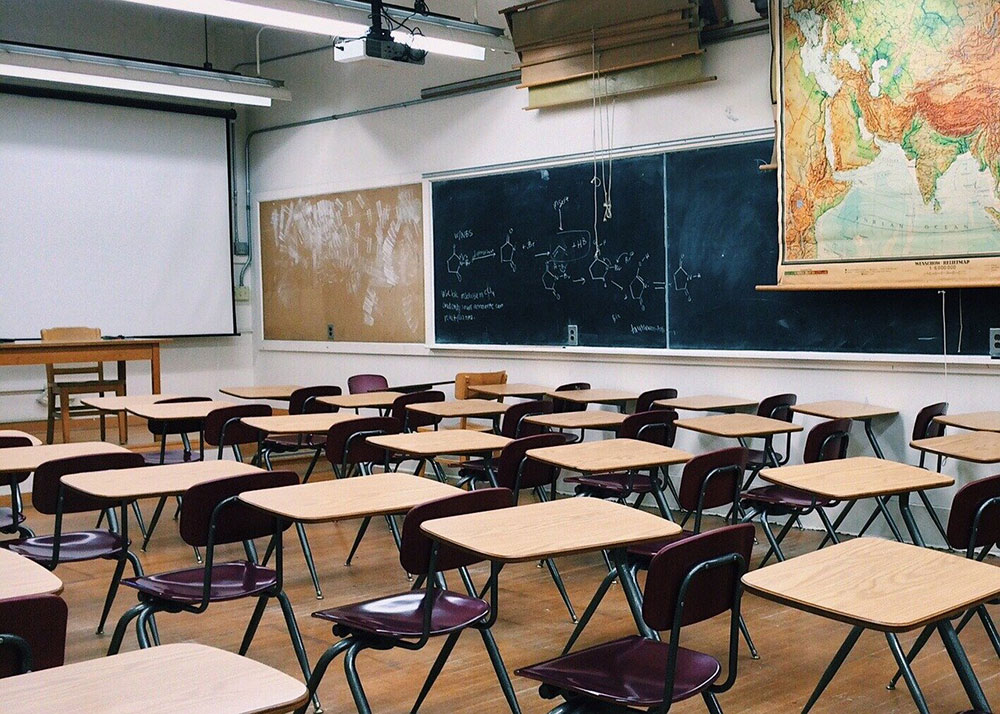
The relationship between noise levels and academic performance is now well-established. In many countries, schools are even awarded specific certifications if they manage to keep noise levels below certain thresholds. Sometimes, these certifications are followed by monetary awards in the form of funding. Today, however, in many school buildings, the average sound level still exceeds 65 dB; this significantly affects students’ attention levels and plays an important role in determining their performance. Here, then, are four acoustic solutions for classrooms.
1) Amplifying the teacher’s voice
Students’ voices, noise generated by ventilation and air conditioning systems, as well as traffic noise, significantly interfere with teaching. Suffice it to say that in a standard-sized classroom, speech intelligibility is reduced by 50% as early as the fourth row; if there are students with hearing impairments, this problem is further exacerbated.
More and more often, teachers rely on technology to amplify their voices so they can be heard and overcome other sounds. This expedient is very useful when the teacher addresses the whole class; however, the artificially amplified voice can generate background noise, sometimes due to reverberation. In particular, this problem occurs when students are still and silent: the background noise generated by the amplifier or microphone disturbs their learning ability; conversely, this will be exacerbated when students work in groups and interact with each other, learning interactively. In this case, in fact, they move and create additional background noise, which overcomes that generated by the teacher’s microphone.
2) Installing acoustic doors and glazing
Noise coming from outside the classroom (traffic, roadworks, students in corridors or outdoors) can be a major distraction and, naturally, the sources producing it cannot be controlled or inhibited in any way.
Doors and windows are the main culprits, allowing outside sound to enter the classroom. Windows can be made more insulating by installing sound-absorbing glass, which protects against unwanted noise.
In addition, doors can also be installed to improve overall acoustics. The space below and around the door will still let noise in; to overcome this problem, seals can be used to reduce the amount of noise coming from outside the classroom.
3) Installing acoustic ceilings
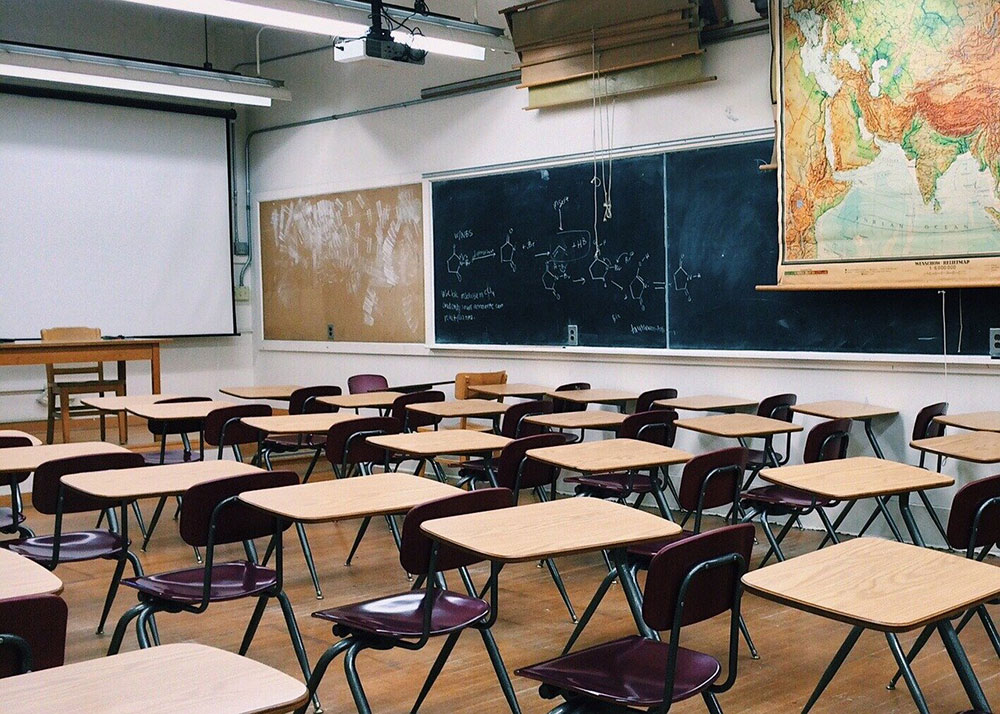
If restoration work is being carried out in the school, installing acoustic ceilings could be a winning choice, potentially significantly reducing noise levels in classrooms. These acoustic solutions for classrooms have a dual utility: they are also able to reduce reverberation in environments.
4) Limiting hard surfaces
Among the acoustic solutions for classrooms, the fourth actually has a dual purpose. Hard surfaces do not absorb sound and these are often found in abundance in schools: main examples include floors, desks, tables, and chairs. Limiting these hard surfaces, therefore, can be an excellent idea.
Furniture
Using upholstered chairs will help improve sound absorption and will have the added benefit of improving student comfort. Curtains or blinds on windows will help absorb sound inside the classroom and also help block sound coming from outside.
Flooring
Very often in classrooms and school buildings, flooring is mostly composed of hard tiles, considered quick and easy to clean. However, hard floors do not allow for sound absorption and contribute significantly to the formation of background noise, which disturbs the environment. An acoustic solution for classrooms could be textile flooring, which features excellent sound-absorbing materials. Studying and learning in an acoustically better environment is certainly beneficial for students. A secondary property of textile flooring is comfort. Among the acoustic solutions for classrooms, this is also highly appreciated by teachers, who must remain standing for long periods.