Sound Masking: How It Works and How to Implement It
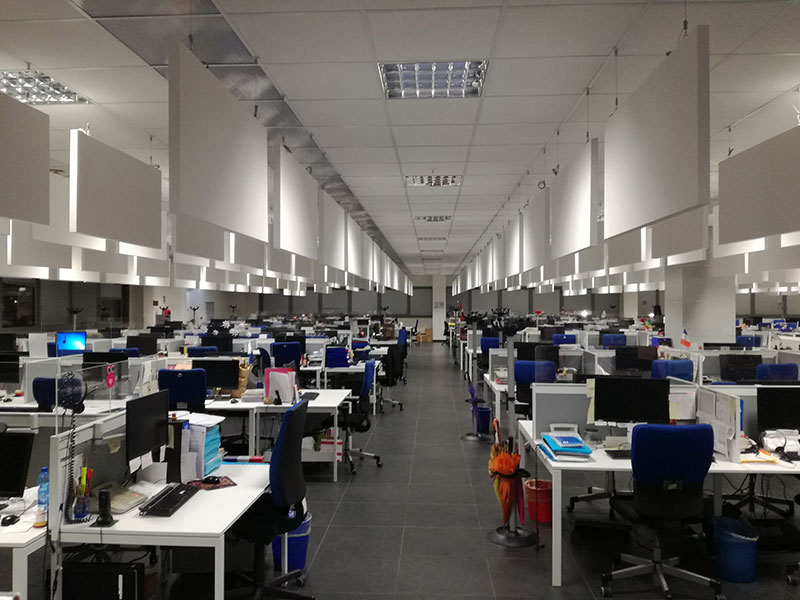
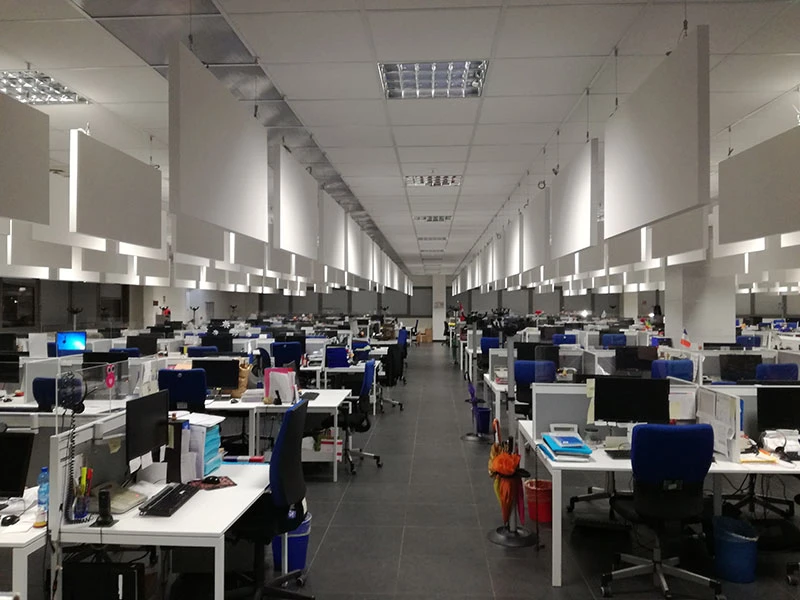
When faced with an acoustic problem such as a noisy office, the main cause is often overlooked. The design and architecture of modern offices favor open floor plans and collaborative workspaces that lack, however, the ubiquitous partition walls, carpets, and even ceiling acoustic panels that many of us are accustomed to seeing. As a result, the ambient noise level within the space can become a serious obstacle for those trying to work and concentrate.
Many of these spaces also use particular materials such as glass and wood that can create additional problems by causing reverberation. A masking system is a solution capable of effectively alleviating acoustic problems without compromising the aesthetics of a space. It therefore becomes necessary to understand the different systems on the market and, more generally, how sound masking works.
How does sound masking work?
This system consists of raising the ambient background sound in a defined area, filling it uniformly with a clean, non-intrusive sound. A good example that helps understand the principle of this technique is to think of a large auditorium with two people standing at opposite ends. They speak to each other using a normal tone of voice and have no problem hearing and understanding each other. Now, imagine that the auditorium contains fifty people—the noise in the environment would certainly become more intense, making it much more difficult for those two original occupants to hear and understand each other. This same principle applies to the office taken as an example from the beginning.
The background noise of a quiet office is around 40 dB (decibels), while the normal volume of speech is approximately 50 dB. With voices being so much louder relative to ambient noise, it becomes almost impossible not to hear conversations between the various individuals present, as anyone within earshot can hear and understand conversations, making concentration difficult. Sound masking, in this case, aims to increase the ambient volume to approximately 47-48 dB, bringing the background level more in line with that of speech. This results in reduced intelligibility: other conversations blend into the ambient noise and no longer translate into a distraction.
How is a sound masking system constructed?
Speakers are generally used, which are installed in the plenum (the space above the ceiling and below the roof, where they remain out of sight). They fill the plenum with sound that then filters through the ceiling acoustic panel, providing uniform and broad coverage. For spaces that forgo ceiling panels and opt for a more exposed style, there are also decorative speakers that can be installed on ceilings, walls, or even on desktops, matching the décor and color of the space.
For mixed-use spaces, some systems are available on the market that have the ability to divide the environment into zones that can be controlled independently of each other. Speakers in open office areas can be set to turn on and off at specific times of the day or automatically raise or lower their masking level based on peak hours. Private offices, on the other hand, can be set as a separate zone where masking always remains at the same level. Speakers used for masking can also be employed to emit music and paging, all controlled from a central location.
Dynamic range
The reason why sound masking is such an effective way to prevent voices from being heard too clearly and to reduce distractions is the dynamic range, which indicates the difference between the quietest sound in an area compared to the loudest. As previously stated, sound in many offices hovers around 40 dB, although this largely depends on other mechanical and computer equipment in use. If someone suddenly speaks at a tone of 60 dB, a 20 dB “jump” occurs, which would cause most employees present in the space to be distracted and probably look in the direction from which that sound originated.
If instead the background level is set around 50 dB with a sound masking system, then there will be a jump of only 10 dB (from 50 dB to 60 dB). This dynamic range, therefore, allows this sudden volume jump to be dampened and, in the example given, causes very few people in the office to be distracted.
Types of sound masking systems
There are two main types of sound masking systems. These include:
Traditional systems: power the speakers and are operated individually. Multiple speakers can all be connected, or one of them can control the decibel level produced by all the others.
Networked systems: are controlled by a network control panel and can be automatically programmed to adjust throughout the day.
When choosing a type of sound masking system, it is necessary to consider the long-term use made of it within a space, calculating any future reconfigurations. Reprogramming traditional systems is much more expensive, while networked systems can be reconfigured digitally.