Sound Reflection and Sound Transmission: What Are They?

Sound waves originate from one medium and reach another, like a wave suspended in the air in a room that reaches a brick wall. This wave will undergo certain consequences: part of it will attempt to pass through the medium, in our case the wall, while the remainder will reflect off it, returning back. Sound reflection can be identified in the portion of energy that remains contained within the room. Sound transmission, on the other hand, is characteristic of that portion of energy that, conversely, is able to pass through the wall. In both cases, the sound wave is transferred as energy from molecule to molecule. The medium, therefore, is any form of matter composed of molecules. For example, it can be the air we breathe, water, the concrete floor, or the wooden boards present within a room. Sound waves are precisely energy that is transmitted between molecules, which capture the vibration created by a sound source and immediately transmit it to those adjacent to them. Since molecules compose all the matter around us, we can understand how sound is transmitted through each element and not only through air.  

Echo and Reverberation

Sound reflection occurs in two ways: as reverberation or as echo. Sound reflection is measured by calculating the time interval from when the original source stops emitting sound to when it is perceived again following its reflection. This time interval is defined as echo or reverberation, based on certain differences. If the gap is greater than one-tenth of a second, then it refers to echo; otherwise, if it is less, to reverberation. Our ear cannot distinctly distinguish sound signals separated by less than one-tenth of a second. Therefore, we can hear two different sound signals in the case of echo, while reverberation appears to us as a single prolonged sound. This concept can be simplified with an example. When we are high in the mountains and shout our name, we must wait a few moments from when we have finished projecting our voice before hearing it return. We are therefore able to perceive two distinct sounds. If, conversely, we are in a bare room and speak, we hear a continuous sound even though our voice seems distorted and “prolonged.” In the first case we experienced echo, in the second reverberation.
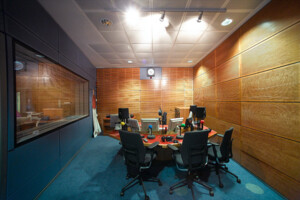
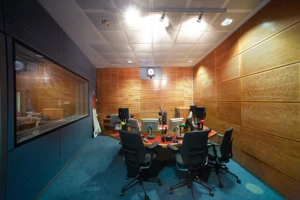
sound reflection - sound transmission

Angle of Reflection and Angle of Incidence

Sound waves reflect off the flat surfaces of a room in such a way that the angle at which they arrive at the surface will be equal to the angle at which they reflect off the surface. In a square or rectangular room with three sets of parallel surfaces, standing waves are generated that repeat the same paths as they travel throughout the room. This gives rise to poorly balanced acoustics and creates “dead” spots within the room where sound waves do not propagate. Conversely, in a room where non-parallel surfaces are present, sound waves are reflected differently each time, making the room acoustically balanced. In summary, sound reflection is the original part of the sound wave that remains enclosed in a room after reflecting off the walls. If sound reflection and the original wave are separated by a time less than one-tenth of a second, the human ear will perceive the first and second as a single prolonged signal. This phenomenon is called reverberation. Therefore, the longer the Reverberation Time, the more background noise will be generated and perceived in the room. If not treated, this noise will cause interference with other sounds produced within the space. Sound reflection, consequently, varies and depends strictly on the frequency of the sound produced by the source, the type of surface in the room, and the configuration of the walls.  

Sound Transmission vs Sound Reflection

In the previous paragraphs we have seen that when a sound wave travels through a room and comes into contact with the walls, a reflected wave is produced that, in turn, reintroduces a portion of the original wave into the room itself. The remaining portion of the initial wave attempts to pass through the walls and, ultimately, to reach the adjacent room. The path taken by this part of “residual” acoustic energy is defined as sound transmission. The passage of the sound wave from one room to another occurs due to the molecular phenomenon we previously referenced. Two adjacent rooms, in fact, share a common wall. Each point of contact between two rooms, therefore, being composed of molecules, will allow the transmission of sound energy from one room to another. However, it must be taken into consideration that the elements present within a common wall cause sound waves to bounce back and forth before definitively transmitting them to the other side. All wall assembly systems, therefore, have a corresponding value that helps measure their ability to “interfere” with sound transmission. This value is called the Sound Transmission Coefficient. In conclusion, sound waves are not like their ocean counterparts that crash against a common surface. Sound reflection allows us to understand how a portion of the sound wave emitted by a source remains within a room. Through sound transmission, instead, we can understand how a part of sound can pass from one room to another due to the transfer of energy between molecules. Since sound travels through the vibrations of these cells, all common contact points between two rooms become conductors for noise.
togel4d
toto slot
slot qris
slot777