


The term audiometric booth is often used as a synonym for soundproof booth. In reality, the term refers to specific soundproof structures used in the medical field to perform hearing-related examinations. Their structure follows complex designs that must take into account specific materials and studies, while not neglecting aesthetic, practical, and functional aspects.
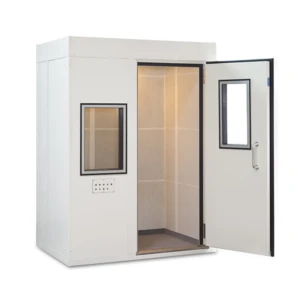
In more technical terms, an audiometric booth can be defined as an integrated system of elements tested in the laboratory and subsequently in the field, which includes panels for walls and ceiling, structurally isolated floors, doors, windows, and silent ventilation systems. The technical equipment, procedure, sound environment, and especially the patient’s well-being and comfort are therefore the key elements for a good audiometric examination and must be kept in mind when purchasing or designing audiometric booths.
The Audiometric Examination
To better understand the characteristics that the design of audiological booths must have, it is first necessary to understand what the audiometric examination consists of: this is the medical test performed inside soundproof booths to detect patients’ hearing capacity.
The procedure, which involves the use of headphones to be placed over the ears, is performed by an audiometric technician who will send sounds to the headphones. It starts from low tones up to high ones and then continues by asking the patient to nod or press a button when they hear the sounds: in this way the physician can determine the subject’s minimum hearing threshold. Devices can also be used that are positioned behind the ear and transmit vibrations directly to the inner ear.
Through the subject’s ability to perceive sounds, the specialist is able to evaluate the functionality of the outer ear and middle ear. Through the use of vibrations, the functionality of the inner ear is evaluated instead.
Choosing a Supplier:
1. The Design Phases
For the construction of booths, a good manufacturer must follow multiple phases to arrive at the complete product, so let’s see what the main ones are:
- Acoustic detection with certified phonometric instrumentation;
- Solution study;
- Technical design;
- Production of integrated systems for acoustic insulation.
2. To ensure good performance, booths must possess fundamental structural elements:
- fire-resistant external panels;
- good and simple assembly capability;
- solid metal load-bearing structure;
- anti-vibration, floating, anti-lock flooring;
- doors designed for acoustic insulation;
- solid, laminated windows mounted on steel frames.
Application Areas of an Audiometric Booth
The audiometric booth, or audiological booth, is used in various settings, from private clinics to public hospitals, universities, health centers, as well as medical offices and research institutes. In particular, they also find application for:
- in the field of speech therapy;
- audiometric screening for pre-employment examinations and employee evaluation tests;
- bone and air conduction hearing tests;
- in education to assess learning;
- distribution of hearing aids;
- behavioral tests.
Other Important Elements to Keep in Mind Before Purchase
- Carry out good preliminary design;
- Installation: evaluate whether your supplier is available and specialized for assembly or if the model includes an installation kit;
- Presence of ventilation systems;
- Evaluate or opt for modular or non-modular systems;
- Compliance with all technical standards: it is important that audiometric booths are designed according to ISO 8253 and ISO BS EN 6189 standards and technical certifications including HTML 2045;
- Presence of an internal lighting system that does not require maintenance.